












 Connect the Dots: Designing for the Future of Manufacturing Reality—Solder Mask and Legend
 Target Condition: An Exploration of Flooding PCB Layers
 Happy’s Tech Talk #47: Automation for Complex Multilayer Fabrication Stackups





New Quantum Phenomena in Graphene Superlattices
September 19, 2017 | Graphene FlagshipEstimated reading time: 2 minutes
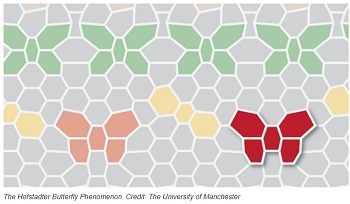
A team of Graphene Flagship researchers led by the University of Manchester reported in the journal Science showing the first new type of quantum oscillation to be reported for thirty years. This occurs by applying a magnetic field and it is the first of its kind to be present at high temperature and on the mesoscale. This research also sheds light on the Hofstadter butterfly phenomenon.
Quantum theory is the study of physics at the atomic and sub atomic level. It quantises energy and momentum and shows how objects are characterised as both particles and waves. Quantum oscillations can be used to map the properties of new materials in the presence of a magnetic field. This paper shows how it is possible to tune the magnetic field applied to a heterostructure comprising of graphene and boron nitride to create a whole host of different electronic materials.
The superlattice, created in graphene by its exact placement with regards to a periodically arranged boron nitride layer, interacts with the magnetic field in such a way that it is possible to tune its oscillation to manufacture bands and gaps in its electronics structure – meaning that the magnetic field can be used to tune the materials to be metallic, semiconducting or conducting.
Andre Geim, a leading member of the team and the 2010 Nobel Laureate, says “Oscillatory quantum effects always present milestones in our understanding of materials properties. They are exceedingly rare. It is more than 30 years since a new type of quantum oscillation was reported.” He added “Our oscillations stand out by their extreme robustness, happening under ambient conditions in easily accessible magnetic fields.”
This work also sheds further light on Hofstadter’s butterfly, a fractal pattern that describes the behaviour of electrons in a magnetic field, measured experimentally for the first time in 2013 using a graphene and boron-nitride heterostructure. In the original theoretical work on which Hofstadter’s butterfly is based the electrons modelled to create the fractal pattern were treated as Bloch electrons (electrons that do not interact with one another and move within a periodic electric potential within a lattice). The research shown here illustrates how these complex fractal patterns can be viewed as Langmuir quantisation which is the quantisation of cyclotron orbits (taking what is normally thought of as a circular orbit and instead viewing it as linear).
Professor Vladimir Falko, Director of the National Graphene Institute commented “Our work helps to demystify the Hofstadter butterfly. The complex fractal structure of the Hofstadter butterfly spectrum can be understood as simple Landau quantisation in the sequence of new metals created by magnetic field.”
Professor Bart van Wees, Head of the Physics of Nanodevices group at the Zernike Institute for Advanced Materials, Groningen, The Netherlands added “We have always considered quantum oscillations as very brittle, easily destroyed at higher temperatures but the authors have shown that these can now be observed at room temperature, or even higher. This is good news for possible new applications of these and other systems which are based on Van der Waals stacking of two-dimensional materials.”
Share on:


Testimonial
"In a year when every marketing dollar mattered, I chose to keep I-Connect007 in our 2025 plan. Their commitment to high-quality, insightful content aligns with Koh Young’s values and helps readers navigate a changing industry. "
Brent Fischthal - Koh YoungSuggested Items
AGC's Advanced PCB Material Solutions
04/17/2026 | Real Time with... APEX EXPOAGC's line includes advanced PCB materials for critical industries such as aerospace, defense, and medical. This interview highlights their commitment to North American sourcing, offering solutions to today's challenges. AGC provides specialized automotive PCB materials including fastRise, a low-loss non-reinforced prepreg designed for high-frequency applications like 77 GHz radar.
What’s Next for PCB Materials? I-Connect007 Podcast Series Turns to Supply Chain Resilience
04/16/2026 | I-Connect007 Editorial TeamI-Connect007 continues its six-part podcast series with Isola experts titled, PCB Materials: The Backbone and Future of Electronics, with the release of Episode 5, which shifts focus to one of the industry’s most urgent challenges: supply chain resilience.
Indium Showcases Solder Alloy Reliability Research for Heterogeneous Integration at ICEP-HBS
04/15/2026 | Indium CorporationIndium Corporation Senior Global Product Manager, Semiconductor and Advanced Materials, Sze Pei Lim will present a collaborative International Electronics Manufacturing Initiative (INEMI) project comparing SnBi and SAC305 solder alloys for first-level interconnects in complex heterogeneous packages.
Podcast Hits the Mark in a Materials Market
04/15/2026 | Marcy LaRont, I-Connect007The base material of a printed circuit board is its literal and functional foundation. Isola, founded in 1912 in Düren, Germany, is one of the longest-standing manufacturers of glass-reinforced laminates in the electronics industry. Originally focused on insulation and fiberglass materials, the company played an early role in supplying the foundational substrates that enabled the growth of PCB technology. As electronics advanced, Isola evolved alongside the industry, expanding from basic glass-epoxy laminates into high-performance copper-clad materials and engineered prepregs.
SMTA Ultra HDI Symposium, Day 2: Fragile Supply Chains, Fierce Innovation
04/14/2026 | Marcy LaRont, I-Connect007The Arizona weather yielded another beautiful day as we gathered for the second day of SMTA’s annual UHDI symposium. After the first full day discussing the role of AI in business and the how-tos of implementation, Avondale Mayor Mike Pineda kicked off day two, proud to showcase his city and to declare its important place in the continued development of the West Valley, an increasingly important area for tech and manufacturing.