











 Beyond Design: How Signals Survive the Hostile PCB Environment
 Connect the Dots: What Designers Should Know About Non-conductive Via Fill
 Target Condition: The Modern Masters of Signal Integrity and AI-driven Design





Manufacturers are under increasing pressure to improve reliability while reducing production costs, energy use, and environmental impact. For companies that rely on conformal coatings to protect electronic assemblies from moisture, dust, chemicals, and other environmental hazards, UV-curable technologies are a compelling alternative to traditional coating processes.
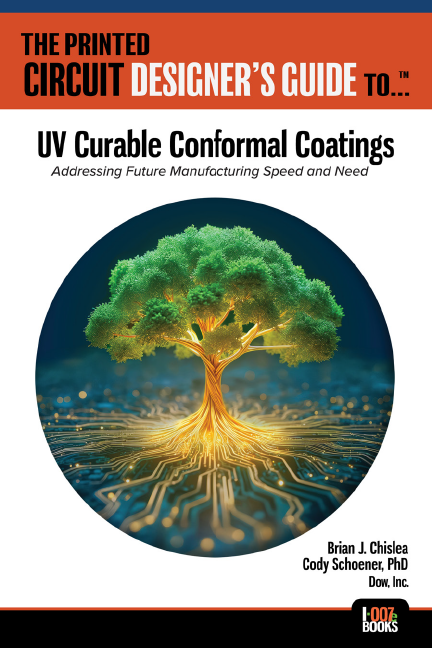
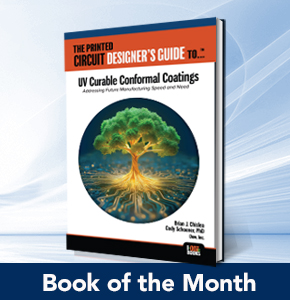
In their book, The Printed Circuit Designer’s Guide to…™ UV Curable Conformal Coatings, authors Brian J. Chislea and Dr. Cody Schoener examine how UV curable coatings can help manufacturers protect assemblies while also improving throughput, reducing waste, and lowering operating costs. Here are three key takeaways from the guide that may help you.
1. UV Curable Coatings Help Protect Assemblies While Speeding Production
Conformal coatings are critical to improving the reliability and longevity of electronic products. Whether used in automotive systems, aerospace applications, medical devices, or consumer electronics, these protective materials help prevent corrosion, contamination, and premature failure.
The authors explain how UV curable coatings provide the same essential protection expected from conformal coating technologies while offering a major manufacturing advantage: speed. Unlike conventional coatings that may require lengthy cure cycles, UV curable materials cure within seconds when exposed to ultraviolet light. That faster cure time can help manufacturers increase throughput, reduce bottlenecks, and make better use of production space.
2. Sustainability and Cost Savings Can Work Together
UV-curable conformal coatings also support manufacturers looking to improve environmental performance without sacrificing production efficiency. Many UV curable formulations contain little or no volatile organic compounds (VOCs), helping reduce emissions while also lowering energy consumption and material waste.
For manufacturers balancing sustainability goals with cost pressures, this is an important point. The guide shows how environmental improvements can also yield measurable operational savings, making UV curable coatings a practical option for companies seeking cleaner, more efficient production processes.
3. Real-World Case Studies Show Measurable Manufacturing Gains
The guide also provides practical insight into coating chemistries, application methods, qualification requirements, and industry standards, including IPC-CC-830 and UL certifications. These details help readers better understand how coating materials are selected based on performance needs and operating environments.
Most importantly, the book includes real-world case studies demonstrating the impact of transitioning from conventional coating processes to UV curable systems. Companies reported substantial reductions in labor, material usage, energy consumption, and production footprint, illustrating how UV curable technologies can improve reliability while streamlining manufacturing operations.
To learn more about UV curable conformal coatings, including coating chemistries, qualification requirements, application methods, and detailed case studies, download The Printed Circuit Designer’s Guide to…™ UV Curable Conformal Coatings.


