









-
- News
- Books
Featured Books
- I-Connect007 Magazine
Latest Issues
Current Issue
Beyond the Rulebook
What happens when the rule book is no longer useful, or worse, was never written in the first place? In today’s fast-moving electronics landscape, we’re increasingly asked to design and build what has no precedent, no proven path, and no tidy checklist to follow. This is where “Design for Invention” begins.
March Madness
From the growing role of AI in design tools to the challenge of managing cumulative tolerances, these articles in this issue examine the technical details, design choices, and manufacturing considerations that determine whether a board works as intended.
Looking Forward to APEX EXPO 2026
I-Connect007 Magazine previews APEX EXPO 2026, covering everything from the show floor to the technical conference. For PCB designers, we move past the dreaded auto-router and spotlight AI design tools that actually matter.
- Articles
- Columns
- Links
- Media kit
||| MENU - I-Connect007 Magazine
NCAB Group White Papers: Practical PCB Design Guidance for Manufacturable Results
February 25, 2026 | I-Connect007 Editorial TeamEstimated reading time: 1 minute
The I-Connect007 Industry Resource Center brings together expert white papers that help engineers and manufacturers navigate today’s design and manufacturing challenges across the PCB lifecycle.
NCAB Group contributes a valuable collection of white papers focused on practical PCB design and manufacturability. Drawing on their experience with a global network of production partners, NCAB helps engineers align design intent with fabrication realities: reducing risk while improving consistency and long-term reliability.
In “Semi-Flex Design Guidelines,” the team addresses applications that require limited bending without the added cost and complexity of fully flexible circuits. The paper explains how designers can select thin rigid FR-4 materials to enable controlled bending during installation, while emphasizing that semi-flex designs are best suited for static or limited-bend applications. Key considerations include minimum bend radius, copper distribution in bend areas, layer symmetry, and the use of flexible solder mask or coverlay to reduce mechanical stress.
NCAB extends its design-for-manufacturing approach in “Ultra HDI Design Guidelines,” which tackles the challenges of shrinking geometries and increasingly dense interconnect structures. The paper outlines practical design rules for microvias, pad sizes, dielectric thicknesses, and stackups that support both manufacturability and electrical performance as designs move beyond traditional HDI limits.
In “Stackups and Impedance Design Guidelines,” the focus is on the structural foundations that support signal integrity. This paper explains how symmetrical stackups, controlled dielectric spacing, and consistent copper weights help designers meet impedance targets while minimizing warpage in high-speed and high-frequency applications.
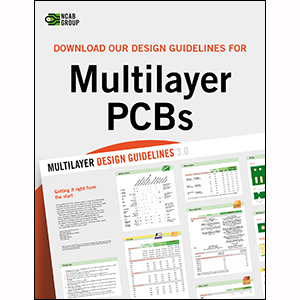
In “Multilayer Design Guidelines,” the authors address copper balance, via strategies, and drilling tolerances. These fundamentals help designers achieve stable manufacturing outcomes as board complexity and layer counts continue to increase.
Together, NCAB Group’s white papers reflect a design-for-manufacturing mindset. By translating fabrication constraints into actionable design guidance, the authors help engineers improve reliability, reduce rework, and achieve more predictable results.
Visit the I-Connect007 Industry Resource Center to explore these resources—and many more—designed to strengthen your PCB design strategy.
Testimonial
"We’re proud to call I-Connect007 a trusted partner. Their innovative approach and industry insight made our podcast collaboration a success by connecting us with the right audience and delivering real results."
Julia McCaffrey - NCAB GroupSuggested Items
PCB Technologies to Exhibit at PCB East 2026
04/23/2026 | PCB Technologies Ltd.Issey Ende, PCB-Technolgies’ VP of Sales and Marketinghas announced that his company will be exhibiting at this year’s PCB East 2026, the premier East Coast conference and exhibition for the electronics design, fabrication, and assembly industry on Wednesday, April 29, 2026, at the DCU Convention Center in Worcester, Massachusetts.
Design for Test: A New Book from The Test Connection, Inc.
04/23/2026 | Real Time with... APEX EXPOBert Horner, president of The Test Connection Inc., shares insights on designing for testability (DFT) challenges with Kelly Dack. Horner discusses the critical need for incorporating testability early in the design process and the importance of quantifiable metrics for measuring test coverage. He highlights The Test Connection's role in transferring decades of 'tribal knowledge' to emerging engineers through training and education. Look for "The Printed Circuit Assembler's Guide to... Design for Test, A Practical Guide to Test and Inspection" in the I-007eBooks library.
Changing Times: Siemens Plans to Sell Former Mentor Graphics Wilsonville Campus
04/22/2026 | Nolan Johnson, I-Connect007Siemens announced it will be selling its Wilsonville, Oregon, property, which has served as the campus for Mentor Graphics, which was later acquired by German EDA-giant Siemens, as reported by The Oregonian on April 20. Siemens will maintain one building on the sprawling 53-acre campus, citing the move to hybrid and remote work over the past few years as a key factor in the decision.
Siemens Collaborates with TSMC to Advance AI for Semiconductor Design
04/22/2026 | SiemensSiemens announced the continuation of collaboration with TSMC to drive innovation in AI-powered automation and advanced semiconductor design enablement.
Standardization, Workforce, and the Road Ahead for Flex–Packaging Integration, Part 3
04/22/2026 | Anaya Vardya, American Standard CircuitsParts 1 and 2 of this series established the technical foundation and application landscape for the convergence of flexible PCBs and advanced semiconductor packaging. Part 3 addresses what comes next: the standards frameworks, talent pipelines, and strategic imperatives that will determine whether the industry can scale this convergence reliably and competitively.