













 Elementary, Mr. Watson: Inside the Display Power Loop
 Powering the Future: Performance Is Won in Assembly
 Connect the Dots: Total Value Manufacturing Solutions





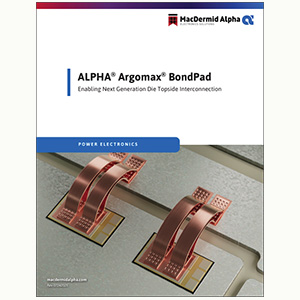
Every advance in power electronics places new demands on semiconductor packaging. As manufacturers push for greater power density, improved thermal management, and smaller form factors, even long-established interconnection methods deserve a fresh look. In its latest white paper, MacDermid Alpha Electronics Solutions examines how a sinter-ready copper foil solution could simplify die topside interconnection while improving performance.
The paper is called “Enabling Next-Generation Die Topside Interconnection (Power Electronics).” Access the paper here. Access the entire Industry Resource Center here for a full list of our white papers.
1. Traditional topside interconnection methods are reaching their limits
For decades, aluminum wire bonding and solder have been the industry's standard solutions for die topside interconnection. However, demanding applications such as electric vehicles, industrial power modules, and RF devices are exposing the limitations of these conventional approaches. As thermal performance, reliability, and power density become more critical, manufacturers are increasingly evaluating alternative interconnection technologies that better support the requirements of next-generation devices.
2. Manufacturing improvements can be just as valuable as material innovations
The paper emphasizes that innovation is not only about developing new materials but also about simplifying production. By combining a pre-applied nano-silver sintering layer with a copper foil, the BondPad concept eliminates several traditional assembly steps, including paste printing, adhesives, and fixturing. Streamlining the process reduces manufacturing complexity while improving yield, throughput, and process consistency. This demonstrates that smarter manufacturing can deliver benefits alongside improved material performance.
3. Fully sintered interconnects are becoming a practical manufacturing option
Perhaps the paper's most significant message is that fully sintered interconnection is moving from an emerging concept to a realistic production strategy. Solutions that deliver high thermal performance while fitting within existing manufacturing workflows make adoption far more achievable than in the past. Rather than requiring manufacturers to completely redesign their production lines, these technologies offer a practical path toward meeting the increasing reliability and performance demands of modern power electronics.
As semiconductor packaging evolves, success will depend on technologies that improve both device performance and manufacturability. This white paper illustrates how advanced interconnection materials can help manufacturers achieve both goals while providing a realistic roadmap for the next generation of power electronics.
Access the paper here. Access the entire Industry Resource Center here for a full list of our white papers.


