















 The Marketing Minute: If Your Marketing Budget Gets Cut in Half, Then What?
 Punching Out: How Are the Big Boys in Electronics Doing?
 It’s Only Common Sense: Complexity Is the Enemy of Profit





AeroVironment Introduces Puma VNS
September 16, 2022 | Business WireEstimated reading time: 1 minute
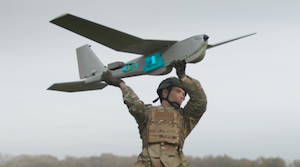
AeroVironment, Inc., a global leader in intelligent, multi-domain robotic systems, introduced Puma VNS, a visual-based navigation system for Puma 2 AE and Puma 3 AE small unmanned aircraft systems (SUAS) that will enable GPS-denied navigation across increasingly GPS-contested environments.
The system will provide operators with continually advanced navigation capabilities, features and functionality through anticipated software and hardware updates. The system will also enable the integration of future autonomy capabilities.
“Puma VNS gives operators an unprecedented advantage in the battlefield,” said Trace Stevenson, AeroVironment vice president and product line general manager for SUAS. “Operators now can execute missions with more confidence in GPS-contested environment with the system’s new navigational capabilities.”
The next-generation navigation system features a suite of down-looking sensors that gather imagery data and track features on the ground, as well as an embedded compute module to process and determine the precise location of an aircraft while it is in flight. Designed with the operator in mind, the system automatically transitions to and from GPS-denied navigation mode without any input from the operator.
Puma VNS is available as an add-on option for new Puma 3 AE system orders and as a retrofit kit for fielded Puma 2 AE and Puma 3 AE systems.
Share on:



Subscribe
Stay ahead of the technologies shaping the future of electronics with our latest newsletter, Advanced Electronics Packaging Digest. Get expert insights on advanced packaging, materials, and system-level innovation, delivered straight to your inbox.
Subscribe now to stay informed, competitive, and connected.
Suggested Items
Kymeta Joins Red Cat Initiative for Maritime Connectivity
05/15/2026 | Globe NewswireRed Cat Holdings, Inc. , a U.S.-based provider of advanced all-domain drone and robotic solutions for defense and national security, announced that Kymeta, a world-leading flat-panel satellite terminal manufacturer, has joined the Red Cat Futures Initiative, the company’s industry-wide consortium accelerating advanced autonomous systems for modern warfare.
SPARK Microsystems Selected for CAD $1M in Government of Canada-backed FABrIC Funding
05/14/2026 | BUSINESS WIRESPARK Microsystems, a Canadian fabless semiconductor company specializing in next-generation short-range wireless communications, has been selected by FABrIC as a CAD $1 million grant recipient funded by the Government of Canada.
System Architecture Beyond the Die With Advanced Packaging as the Scaling Factor
05/14/2026 | Chetan Arvind Patil, Marvell TechnologyIn conventional monolithic semiconductor design, system integration was achieved within a single die and constrained by reticle limits. Compute cores, cache, memory controllers, and input output (I/O) interfaces were all co-optimized on a single process node, with performance closely tied to transistor density and on-die interconnect efficiency. This monolithic system-on-chip (SoC) approach enabled low-latency communication and relatively straightforward power delivery. However, as design for compute-intensive SoCs approaches reticle limits and advanced-node costs increase, the ability to continue scaling within a single die begins to diminish.
Rethinking Reinforcement Materials for Advanced Packaging
05/14/2026 | Ivana Ivanovic, Flexiramics B.V.Materials that once quietly supported the industry are now becoming limiting factors. The electronics industry is experiencing unprecedented pressure as RF systems push into mmWave frequencies, high-speed digital architectures advance into their next performance generation, and power densities climb across automotive, telecom, aerospace, and computing. Reinforcement materials, long treated as a background detail in laminate design, are suddenly at the centre of performance, reliability, and supply‑chain discussions.
Below the Surface: Active Component and Module Submounts—The Architecture Behind Performance
05/14/2026 | Chandra Gupta -- Column: Below the SurfaceIf you were to peel back the layers of a modern electronic system, such as a satellite transceiver, a LiDAR module, or a 5G base station, you would not immediately notice a specific component doing some of the most important work. It doesn’t amplify signals, emit light, or process data, yet without it, none of those functions would be stable, reliable, or scalable. That component is the active device submount.