














-
- News
- Books
Featured Books
- I-Connect007 Magazine
Latest Issues
Current Issue
Beyond the Rulebook
What happens when the rule book is no longer useful, or worse, was never written in the first place? In today’s fast-moving electronics landscape, we’re increasingly asked to design and build what has no precedent, no proven path, and no tidy checklist to follow. This is where “Design for Invention” begins.
March Madness
From the growing role of AI in design tools to the challenge of managing cumulative tolerances, these articles in this issue examine the technical details, design choices, and manufacturing considerations that determine whether a board works as intended.
Looking Forward to APEX EXPO 2026
I-Connect007 Magazine previews APEX EXPO 2026, covering everything from the show floor to the technical conference. For PCB designers, we move past the dreaded auto-router and spotlight AI design tools that actually matter.
- Articles
- Columns
- Links
- Media kit
||| MENU - I-Connect007 Magazine
Improving Method to Recycle and Renew Used Cathodes from Lithium-Ion Batteries
April 18, 2019 | University of California San DiegoEstimated reading time: 2 minutes
Researchers at the University of California San Diego have improved their recycling process that regenerates degraded cathodes from spent lithium-ion batteries. The new process is safer and uses less energy than their previous method in restoring cathodes to their original capacity and cycle performance.
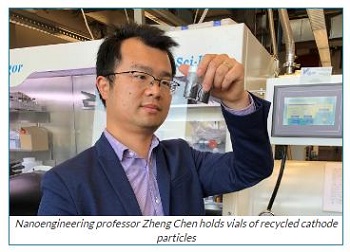
Zheng Chen, a professor of nanoengineering who is affiliated with the Sustainable Power and Energy Center at UC San Diego, led the project. The work was published in Advanced Energy Materials.
“Due to the rapid growth of electric vehicle markets, the worldwide manufacturing capacity of lithium-ion batteries is expected to reach hundreds of gigawatt hours per year in the next five years,” Chen said. “This work presents a solution to reclaim the values of end-of-life lithium-ion batteries after 5 to 10 years of operation.”
Chen’s team previously developed a direct recycling approach to recycle and regenerate degraded cathodes. It replenishes lithium ions that cathodes lose over extended use and restores their atomic structures back to their original states. However, that process involves pressurizing a hot lithium salt solution of cathode particles to around 10 atmospheres. The problem is this pressurizing step raises costs and requires extra safety precautions and special equipment, said Chen.
So the team developed a milder process to do the same job at ambient pressure (1 atmosphere). The key was using eutectic lithium salts—a mixture of two or more salts that melts at temperatures much lower than either of its components. This combination of solid lithium salts produces a solvent-free liquid that researchers can use to dissolve degraded cathode materials and restore lithium ions without adding any extra pressure in the reactors.
Illustration of the process to restore lithium ions to degraded NMC cathodes using eutectic molten salts at ambient pressure. Image courtesy of Advanced Energy Materials/Chen lab
The new recycling method involves collecting cathode particles from spent lithium ion batteries and then mixing them with a eutectic lithium salt solution. The mixture is then heat treated in two steps: it is first heated to 300 C, then it goes through a short annealing process in which it is heated to 850 C for several hours and then cooled naturally.
Researchers used the method to regenerate NMC (LiNi0.5Mn0.3Co0.2), a popular cathode containing nickel, manganese and cobalt, which is used in many of today’s electric vehicles.
“We made new cathodes from the regenerated particles and then tested them in batteries built in the lab. The regenerated cathodes showed the same capacity and cycle performance as the originals,” said Yang Shi, the first author who performed this work as a postdoctoral researcher in Chen’s lab at UC San Diego.
“In an end-of-life lithium-ion battery, the cathode material loses some of its lithium. The cathode’s crystal structure also changes such that it’s less capable of moving ions in and out. The recycling process that we developed restores both the cathode’s lithium concentration and crystal structure back to their original states,” Shi said.
The team is tuning this process so that it can be used to recycle any type of cathode materials used in lithium-ion and sodium-ion batteries.
“The goal is to make this a universal recycling process for all cathode materials,” Chen said. The team is also working on a process to recycle degraded anodes, such as graphite as well as other materials.
Chen is also collaborating with UC San Diego nanoengineering professor Shirley Meng, who is the director of the Sustainable Power and Energy Center, to identify subtle changes in the cathode microstructure and local composition using high-resolution microscopic imaging tools.
Testimonial
"Our marketing partnership with I-Connect007 is already delivering. Just a day after our press release went live, we received a direct inquiry about our updated products!"
Rachael Temple - AlltematedSuggested Items
EDADOC: Building the ‘Neural Hub’ for High-Compute Chips Within a Compact Space
04/28/2026 | ECIOEvery chip to the market must pass a stringent checkpoint before shipment known as ATE testing. Serving as the physical “neural hub” that connects test equipment worth millions of dollars with the device under test, the performance of the ATE test board directly determines the accuracy, efficiency, and final yield of chip testing. Amid the rapid rise of high-compute chips, what extreme challenges is this seemingly small circuit board facing? How is EDADOC addressing industry pain points through its one-stop “design + manufacturing” model?
Driving Innovation: Selecting the Right Laser Source
04/28/2026 | Simon Khesin -- Column: Driving InnovationWhen I first joined Schmoll Maschinen, I brought experience from almost every PCB process, except for laser. As I immersed myself in laser processing, I realized why it can seem so daunting to a newcomer. The complexity arises from three intersecting factors: A vast variety of laser sources: CO2, UV-nano, green-pico, UV-pico, IR-pico, and others; a diverse range of applications: Drilling, cutting, ablation, and more; and an extensive list of materials: These have vastly different absorption rates. Choosing the right machine or laser source is rarely trivial. Even for experienced engineers, answering "Which source is best?" requires examining the business's specific goals.
Market Insights with Pluritec's Maurizio Bonati
04/23/2026 | Real Time with... APEX EXPONolan Johnson interviews Maurizio Bonati, VP of Sales at Pluritec, at APEX EXPO 2026. Bonati details Pluritec's three product divisions, covering a broad spectrum of PCB manufacturing. He discusses the current robust electronics market, driven by AI applications in Asia and technological investments in North America, while noting slower demand in Europe. The interview highlights key sectors like data centers, AI, and medical that benefit from advanced electronics.
Koh Young Technology Brings Proven 3D Metrology Expertise to the Advanced Packaging Stage at ECTC 2026
04/21/2026 | Koh Young AmericaKoh Young, the industry leader in True3D™ measurement-based inspection solutions, is bringing its battle-tested platform to where that challenge is being solved at the 2026 IEEE Electronic Components and Technology Conference (ECTC), May 26–29, at the JW Marriott & The Ritz-Carlton Grande Lakes in Orlando, Florida. The advanced packaging industry is demanding a level of inspection precision that traditional metrology simply cannot deliver, and Koh Young is ready to meet that moment.
Smart Automation: The Journey of a Component Through an SMT Factory
04/22/2026 | Josh Casper -- Column: Smart AutomationIn electronics manufacturing, the SMT line tends to get most of the attention. Placement machines, inspection systems, screen printers, and reflow ovens often take center stage when discussing productivity improvements or new equipment investments. While these systems are obviously critical to the manufacturing process, they only represent a portion of the journey every component takes before becoming part of a finished assembly.