









U.S. Navy Awards General Dynamics $322M for Nuclear-Submarine Support Work
September 17, 2015 | General DynamicsEstimated reading time: 1 minute
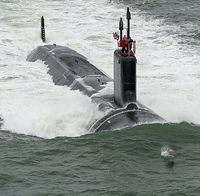
The U.S. Navy has awarded a $321.7 million contract option to General Dynamics Electric Boat to provide planning yard work, engineering and technical support for nuclear submarines. Electric Boat is a wholly owned subsidiary of General Dynamics.
Under this option, Electric Boat will provide design, engineering, material and logistics support, and research and development activities for active U.S. submarines and submersibles. Electric Boat also will provide information services, planning, scheduling and technical support for submarine maintenance and modernization activities, training and facility support, and affordability/cost reduction support.
The contract will be worth approximately $1.5 billion over five years if all options are exercised and funded.
This work will engage Electric Boat's engineering and design organization, which comprises more than 4,400 employees. Possessing proven technical capabilities, these employees work on all facets of the submarine life cycle from concept formulation and design through construction, maintenance and modernization, and eventually to inactivation and disposal.
Electric Boat has established standards of excellence in the design, construction and life-cycle support of U.S. Navy submarines. In its position as an industry leader, Electric Boat remains committed to advancing its technical strengths, while providing the business expertise to effectively manage the challenges of nuclear-submarine production. The company's primary locations are in Groton, Conn., New London, Conn., and Quonset Point, R.I. Its current workforce is approximately 14,000 employees.
Testimonial
"In a year when every marketing dollar mattered, I chose to keep I-Connect007 in our 2025 plan. Their commitment to high-quality, insightful content aligns with Koh Young’s values and helps readers navigate a changing industry. "
Brent Fischthal - Koh YoungSuggested Items
ACCM Unveils Negative and Near-zero CTE Materials for Large-Format AI Chips
04/21/2026 | Advanced Chip and Circuit MaterialsAdvanced Chip and Circuit Materials, Inc. (ACCM) has launched two new materials: Celeritas HM50, with a negative coefficient of thermal expansion (CTE) of -8 ppm/°C to offset the positive CTE and expansion of copper with temperature on circuit boards, and Celeritas HM001, with near-zero CTE and the low-loss performance needed for high-speed signal layers to 224 Gb/s and faster in artificial intelligence (AI) circuits.
FlashPCB Names Matthew Belknap Production Manager as Operations Continue to Ramp
04/21/2026 | FlashPCBFlashPCB, a leading provider of quick-turn PCB assembly, has promoted Matthew Belknap to Production Manager, following his recent start with the company earlier this year.
FlashPCB Welcomes Adam Broeckert, EIT as Manufacturing Engineer
04/20/2026 | FlashPCBFlashPCB, a leading provider of quick-turn PCB assembly, is pleased to announce the addition of Adam Broeckert, EIT, as Manufacturing Engineer.
Single Pair Ethernet (SPE): A Valuable Option for Modern Designs
04/20/2026 | Marcy LaRont, I-Connect007When it comes to designing PCBs and full systems for increasingly complex electronics hardware, who doesn’t want to reduce complexity and cost? Single-Pair Ethernet (SPE) has emerged as a solution and is gaining rapid attention across industrial electronics and PCB design because it enables Ethernet communication over a single twisted pair, replacing the traditional two- or four-pair cabling used in standard Ethernet networks. This seemingly simple shift has significant implications for designers: smaller connectors, reduced cable weight, longer reach, and the ability to carry both data and power over a single pair.
DARPA Launches HARQ Program to Integrate Diverse Qubits for Scalable Quantum Computing
04/20/2026 | DARPADARPA has launched the Heterogeneous Architectures for Quantum (HARQ) program, an effort aimed at overcoming one of the most persistent barriers in quantum computing: how to move beyond single-technology systems to achieve and scale practical, high-impact applications.