





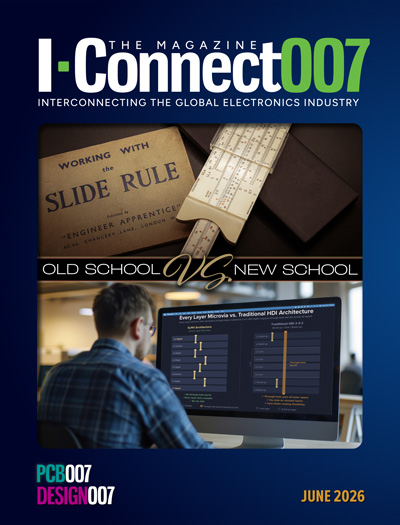

 Marcy’s Musings: Old School vs. New School—When Does It Matter?
 The Hidden Enabler of Autonomous Warfare: Advanced PCB Technologies Behind Defense AI
 It’s Only Common Sense: Stay Curious, My Friends


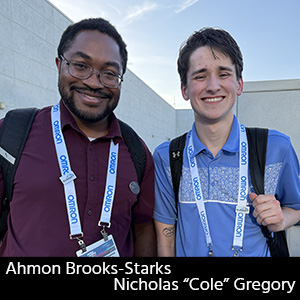
While attending the Newcomers Reception at APEX EXPO 2026, I visited with Ahmon Brooks-Starks and Nicolas “Cole” Gregory, two new members of the Global Electronics Association’s Emerging Engineer Program. You might be a bit surprised at their backgrounds, but (hint) having a foundation in science has translated well into their jobs at Summit Interconnect.
Michelle Te: Ahmon and Nicolas, it’s nice to meet you. Let’s start by learning about what drew you into this industry?
Nicolas "Cole" Gregory: For me, it was kind of just a little bit of serendipity because I had just been let go from my job last February with the federal government due to budgetary issues.
I was back at home trying to find a new job, and I saw a posting for a lab technician at Summit Chicago. I thought I could probably do that. I ended up getting that job, and since then I’ve been learning so much about circuits.
Te: So, you didn't really have that much knowledge about circuit boards before working at Summit?
Gregory: Oh, no, I studied geology at the University of Iowa. It’s very different from what I’m doing now, but geology itself is a very diverse knowledge base. I think that definitely helped, at least in the transition into the more circuit board side of stuff, learning how it all works, especially plating. It mimics some natural processes.
Te: That’s the first time I've ever heard anyone enter the electronics field with a geology major. Ahmon, how did you get your start in the industry?
Ahmon Brooks-Starks: I've always been interested in the exploration and the problem-solving of engineering, but as far as printed circuit boards, it was not on my radar. Honestly, I had no idea about this industry. I started off working in a startup for medical devices, but that didn't go so well. I was also looking for a job, and I saw a job on the Summit site here in Anaheim to work in lamination. I thought that sounded interesting and had the sort of problem-solving I was interested in, so I just went for it. I’m now working as a wet process engineer.
I found out there's a lot that goes into this industry and there's a lot to learn, and I've been sticking with it.
Te: How long have you been with Summit, and what did you study in school?
Brooks-Starks: I studied chemical engineering at Cal Poly Pomona, and I’ve been at Summit for a year.
Te: Both of you are fairly new to the industry and circuit boards, so what’s something that has surprised you about it?
Brooks-Starks: For me, I was surprised by the structure of the industry. It used to be a lot of small mom-and-pop shops, and that’s changed, but they’re also very connected. I also like the way the industry develops through this Emerging Engineer program. It’s for very active learners.
Gregory: What really surprised me was just how complex circuit boards are. I had never really thought about how much goes into a circuit board, and even in my year in the industry, I've just learned that there's so much, from the supplier to the processing side, to the fabricators, to the assemblers, to the OEMs. There are so many aspects of the industry, and I’ve found it to be really cool.
Te: Even though you’re both new to the industry, in what ways could you see yourself making an impact? Do you see yourself continuing to work with PCBs?
Gregory: I could stay in this industry for a long time. The way I would want to impact it is to better refine the microsectioning technique and standards, make them easier to implement for everybody, and make it harder to do it wrong. It’s much easier just to do it the right way the first time. I’d like to help to create new diagnostic criteria for any kind of issues that might arise, especially in the future with all these new greater things that they're pushing for.
Brooks-Starks: I've definitely been enjoying the industry, and I'd like to branch out and learn more so that I can understand how to properly set up a process to do high-level board manufacturing. I want to really understand from a design standpoint, the chemistry, and how the process can affect different modes of failure, and then scale that into new processes and new technology. That'd be really fun.
Te: As a chemical engineering major, are you able to apply what you’ve learned to your current job or is it completely different?
Brooks-Starks: It’s a little bit of both. They put me in inner layers, outer layers, graphics, as well as ENIG. You definitely get quite a bit of chemistry and say, final finishes. But there are things that I encounter, such as graphics as well.
Te: What’s a technology today that excites you?
Gregory: What's really been exciting me are all the new grinders and other lab equipment. Those things will make my life that much easier as well as allow us to process more coupons better so we can actually lock in and get the processes kind of perfect to where they need to be.
Brooks-Starks: I've enjoyed learning some of the advanced chemistry from final finishes. As for inner layers, I'd love to learn how to make boards smaller and reduce line and space, as we start needing that more and more.
Te: You’ve only been in the industry a short time and you’re already seeing how you can make even small improvements. Who is your mentor and how has participating in the Emerging Engineer program helped you?
Gregory: This is my first year doing it, and the way that they've implemented it has definitely been a good one. My mentor is Russell Shepherd. It gets us connected and helps kickstart our careers as we network with other people in the industry. It’s expanded my understanding of what we need to be considering when we’re fabricating or any other aspect of it.
Brooks-Starks: My mentor is Mike Carano. I've enjoyed the program a lot. It's given me a lot of opportunities to focus more on learning and networking. That's pretty valuable. and it's just been a good experience.
Te: Thank you, Ahmon and Nicolas. Best of luck here at the show


