













 The Marketing Minute: Marketing Is a Team Sport
 The Right Approach: Old Philosophies, New Tools
 Trouble in Your Tank: HDI and UHDI—Building the Foundation of Advanced Packaging






It’s been a busy week in the news. I could legitimately have published another five items because there were so many meaningful topics. So, I start with attorney James Kim, who returns to update us on metals tariffs. Brian Chislea and Cody Schoener from Dow recently published a book on UV curable conformal coatings. The Taiwan Printed Circuit Association has launched a PCB-specific AI knowledge base. SEMI FlexTech is seeking proposals for advancing flexible hybrid technologies, and the Global Electronics Association has launched the Global Electronics Policy Council, unifying its advocacy voices.
How New Metals Tariffs Impact the Electronics Industry
Published May 20
James Kim is an attorney specializing in tariff law. He’s returned to the pages of I-Connect007 to update us on the current tariff situation. The U.S. tariff policy continues to be, shall we say, dynamic; and the effects on the supply chain are both immediate and long-lasting. Kim’s insight is well worth the read.
New Book Explores How UV Technology Is Transforming Electronics Protection, Efficiency, and Sustainability
Published May 18
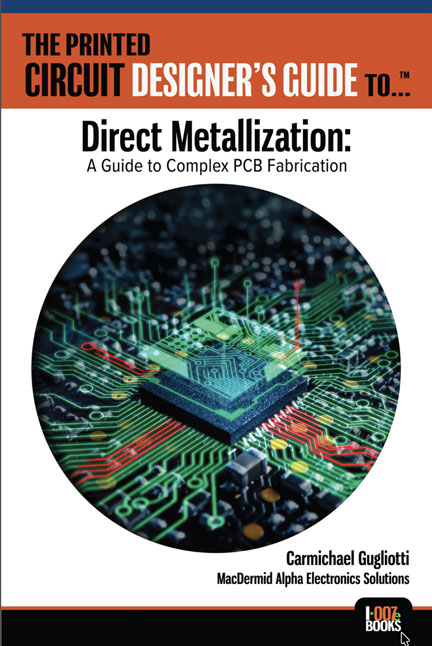
UV-curable conformal coatings protect PCBs from environmental stressors, including moisture, dust, chemicals, and temperature extremes. UV technology enables new capabilities and a reduced environmental footprint. The Printed Circuit Designer’s Guide to…™ UV Curable Conformal Coatings, authored by Brian Chislea and Cody Schoener, PhD, of Dow, Inc., is the latest installment in its highly regarded Printed Circuit Designer’s Guide to…™ book series. Download your copy now.
TPCA Launches AI-Powered PCB GPT Knowledge Platform
Published May 15
The emergence of general-purpose knowledge engines has popularized AI, but trying to know everything about everything all at the same time is merely a concept demonstration, in my opinion. The real power comes when LLMs are developed as subject-matter experts, such as this PCB-centric knowledge platform from TCPA. There will undoubtedly be more of these focused AI resources over time, but TCPA helps lead the way.
SEMI FlexTech Solicits Proposals for Advancing the Future of Flexible Hybrid Electronics
Published May 19
In another example of how increased circuit densities and complexities are reshaping our manufacturing processes, SEMI FlexTech is accepting proposals. Selected projects will receive cash awards ranging from $250,000 to $500,000. The program is funded by the Army Research Laboratory (ARL). The proposals requested are looking for advanced flexible hybrid electronics (FHE) technologies, including the development of advanced materials and additive processing.
Global Electronics Association Launches Global Electronics Policy Council to Unite Industry on Trade, Investment, and Supply Chain Policy
Published May 20
To understand what this is, I’m quoting from the announcement: “The Global Electronics Association announced the formation of the Global Electronics Policy Council (GEPC), a new body uniting leading electronics companies from around the world to advance a coordinated policy agenda across every major region of the electronics supply chain.”
This sort of advocacy work on a global scale is one of the Association’s strengths. This new council will produce an approved global policy agenda and annual advocacy plan, issue formal policy positions and testimony, and deliver quarterly reporting on government engagement activity.
Just for good measure, I’m adding one more item:
Cyberattack via Ransomware at Major EMS Provider Foxconn
Published May 15
As we report here, this is not Foxconn’s first ransomware incident. Previous attacks in 2020 and 2022 impacted facilities in Mexico, reinforcing concerns that manufacturing companies face persistent cyber threats despite increased investment in cybersecurity defenses.
This latest breach is a reminder that cybersecurity is no longer simply an IT issue. For modern manufacturers, it has become a core operational risk directly tied to production continuity, customer confidence, and global supply chain stability. The importance of CMMC certification in the U.S. is the baseline for securing manufacturing data.


