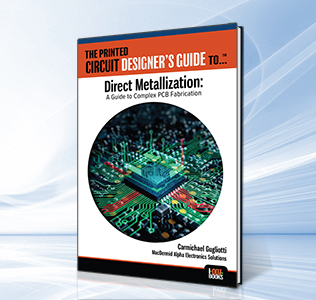





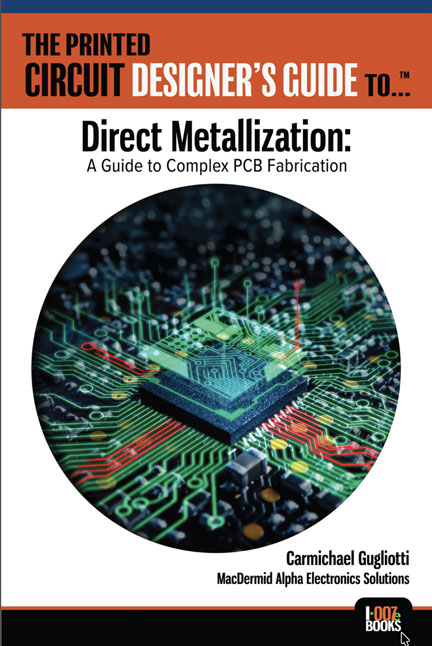



I-Connect007 Releases The Printed Circuit Designer’s Guide to… Direct Metallization: A Guide to Complex PCB Fabrication
May 13, 2026 | I-Connect007Estimated reading time: 1 minute
As PCB complexity continues to accelerate, fabricators and OEMs are reevaluating long-standing manufacturing processes to meet the demands of AI, HDI, advanced packaging, and next-generation electronics. To address these evolving challenges, I-Connect007 is proud to announce the release of The Printed Circuit Designer’s Guide to… Direct Metallization: A Guide to Complex PCB Fabrication, authored by MacDermid Alpha Solution’s Carmichael Gugliotti.
For decades, electroless copper has been the industry standard for making PCB holes conductive. But as reliability expectations increase and sustainability pressures grow, manufacturers are exploring new approaches to advanced PCB fabrication. This new book dives into the innovations, reliability challenges, and breakthroughs in direct copper-to-copper bonding that are redefining the future of PCB manufacturing.
Inside the book, readers will explore:
- Direct metallization vs. electroless copper
- Reliability and microvia challenges
- Pulse reverse plating technologies
- Sustainability advantages in PCB fabrication
- The growing demands of AI, HDI, and advanced packaging
Venkat Raja, president and founder of Advint, Inc., said: “This book is an essential resource for fabricators and OEMs seeking to future-proof their high-density interconnect designs while meeting sustainability targets."
The Printed Circuit Designer’s Guide to… Direct Metallization: A Guide to Complex PCB Fabrication is available now as a free download from I-Connect007.
Get it here today!
Subscribe
Stay ahead of the technologies shaping the future of electronics with our latest newsletter, Advanced Electronics Packaging Digest. Get expert insights on advanced packaging, materials, and system-level innovation, delivered straight to your inbox.
Subscribe now to stay informed, competitive, and connected.
Suggested Items
TPCA Launches AI-Powered PCB GPT Knowledge Platform
05/15/2026 | TPCAThe Taiwan Printed Circuit Association (TPCA) has launched the "PCB GPT Industry Knowledge Platform," which uses generative AI to connect PCB professional knowledge services and help the industry improve the efficiency of cross-border and professional talent training.
I-Connect007 Editor’s Choice: Five Must-Reads for the Week
05/15/2026 | Nolan Johnson, I-Connect007When you work in the news business, even in trade media, you can never really get that far away from it. We never want to miss something important. Chances are, even the books we take on our “vacations” end up having to do with the business. For example, my colleague Michelle Te recommended “Creativity, Inc., by Ed Catmull, a business skills study wrapped up in stories about Pixar, which I brought with me on a trip through the stunning U.S. Mountain West. Now, I’m back, and here are my recommendations for the week.
STARTEAM GLOBAL Achieves A Score in CDP’s Supplier Engagement Assessment
05/14/2026 | STARTEAM GLOBALSTARTEAM GLOBAL has achieved an A score in CDP’s Supplier Engagement Assessment (SEA).
Rethinking Stackup, Materials, and Tolerances in Modern Designs
05/14/2026 | Kristin Moyer, Global Electronics AssociationThe simple rectangular rigid PCB is becoming increasingly infrequent. This reality necessitates designing with concepts well outside traditional rigid PCB methodologies. For example, the designer of wearable electronics may need to implement conductive fibers integrated into the textile material. Heads-up displays, like those in VR/AR headsets and glasses, require transparent circuitry etched into the display glass. The process of designing without a rule book usually starts with something other than the traditional board design process.
Separating Fact from Fear on the FCC ‘China Lab Ban’
05/14/2026 | Jan Pedersen, NCAB GroupRecent news headlines have suggested that the U.S. Federal Communications Commission (FCC) has “banned all testing laboratories in China and Hong Kong.” Understandably, this has created concerns around PCB testing, material approvals, UL listings, and the continued use of established test laboratories in Asia. The good news is that for most PCB, PCB material, and PCBA testing, nothing has changed. Let’s separate fact from fear.