












 Marcy’s Musings: A Frighteningly Good October Issue
 It’s Only Common Sense: Win the Sale Before the RFQ Arrives
 The Marketing Minute: Marketing Is a Team Sport





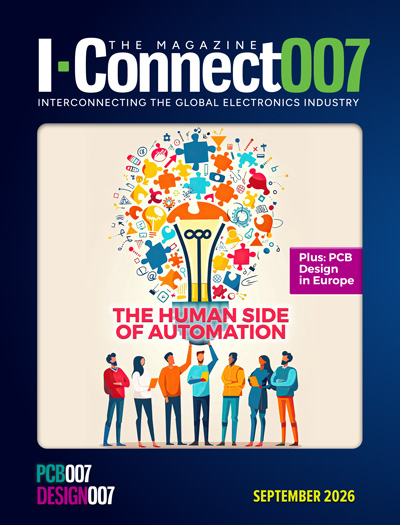
Marcy’s Musings: Automate to Elevate
Automation is a persistent theme in modern electronics manufacturing leading to more efficiency and higher quality more consistently. However, from the U.S. manufacturer’s perspective, automation has historically been synonymous with significant capital expenditures.
I first recall hearing the term in relation to the automobile manufacturing industry. In my younger days, I became familiar with the GM plant in Fremont, California, which was renamed the New United Motors Manufacturing, Inc. (NUMMI) plant after a joint venture with Toyota in the early 1980s. That was the first time the term automation made sense to me, and even in grammar school, it was clear that building cars would be difficult to do any other way.
It has been over 50 years since the merits of automation were first debated, and we are seeing a greater openness to what the technology can offer for companies of all sizes, along with a more balanced view of the real costs of manufacturing products. AI and machine learning (ML) have expanded automation beyond robotics and assembly lines, making it more accessible to a wider audience. ROI timelines are shrinking as the cost of not implementing automation, i.e., the quality and yield fallout that could have been avoided, is increasing to unsustainable levels.
Our lead feature article this month is from Sydney Xiao, president of Global Electronics Association East Asia, who discusses AI and ML in the PCB fabrication space. She highlights the benefits and the steps necessary to advance the industry along this journey. Next, my interview with Henger Microelectronics delves into an AI-focused and highly engineered plasma etching and cleaning system. KLA offers perspective on the value of automation in reducing process steps, increasing quality, and reducing material consumption through their spotlight of the Orbotech NEO inkjet mask machine and process.
From our columnists, Don Ball takes us back to the early days of automation and how it’s evolved over the years, while Happy Holden breaks down the necessary steps for starting a smart factory. Complementing that push toward smarter, more automated operations, Shane Whiteside of PCBAA reminds us that rebuilding a trusted U.S. electronics supply chain—and the policy support to scale it—is essential if we want automation to strengthen manufacturing here at home.
Beyond automation, Steve Williams does a brilliant job in his latest column, in light of the recent U.S. government shutdown, of comparing the leadership styles of past notorious figures to the political power plays of today’s politicians. It’s a unique take on an age-old strategy that disadvantages both public and private groups.
Rounding out this issue, read about my technology tour of American Standard Circuits, get details on a new sustainability toolkit, review updates to the CMMC, and read the profile on Michael Carano in our continuing series on Hall of Fame members from the Global Electronics Association.
It’s all a good reminder that progress never happens in a vacuum. Automation works best when paired with strong leadership, a clear strategy, and a genuine understanding of the broader forces shaping our businesses. I see a manufacturing landscape that’s becoming increasingly complex, yet also filled with possibilities. The advantage goes to the companies willing to lean in, learn, and modernize with intention. Automation is one of the sharpest tools we’ve got. Let’s use it well.
This column originally appeared in the December 2025 issue of PCB007 Magazine.


