













 The Fearless Connector: Why I Chose the Hard Road
 The Clean Truth: The Clean Truth About No-Clean Flux
 Global Sourcing Spotlight: Beyond China Plus One—Building a Truly Global Supply Network





As PCB technology has evolved, the structures being evaluated become more complex. But have the methods used to determine their reliability evolved at the same pace?
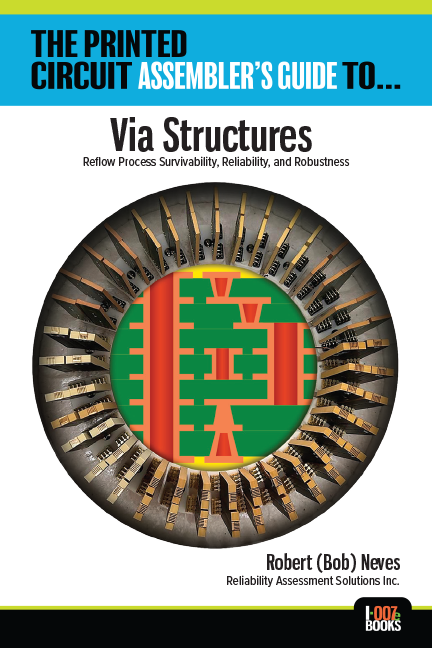
In The Printed Circuit Assembler's Guide to... Via Structures: Reflow Process Survivability, Reliability, and Robustness, Bob Neves challenges some long-held assumptions about how the electronics industry evaluates PCB via structures. He draws on decades of reliability experience, and examines not only how we test, but what those tests actually tell us.
Throughout the book, Neves makes an important distinction between detecting a failure and understanding the conditions that cause it. Here are three key takeaways.
1. Survivability, reliability, and robustness are not interchangeable
This distinction forms the foundation of the book.
Reflow process survivability, reliability, and robustness may all involve stressing and evaluating a PCB, but they answer fundamentally different questions. Reflow process survivability determines whether a PCB can withstand the thermal stresses of assembly. Reliability addresses performance over the product's intended service life. Robustness testing pushes materials and structures beyond expected conditions to compare their relative performance.
Confusing these objectives can lead to equally confused conclusions.
Just as importantly, Neves argues that these assessments need to happen in the right order. Before engineers can meaningfully evaluate long-term reliability or robustness, the PCB must first demonstrate that it can survive the assembly process. If the structure has already been compromised during reflow, subsequent testing begins from a flawed baseline.
The takeaway is deceptively simple: Before selecting a test method, define exactly what you are trying to learn.
2. Established testing methods have limitations that matter more as technology advances
Microsections and daisy chains have played an important role in PCB qualification and failure analysis for decades. Neves doesn't dismiss these methods, but he does challenge the industry to reconsider what conclusions can reasonably be drawn from them.
A microsection provides a detailed physical view of a structure at a particular moment. That makes it valuable for construction verification and failure analysis, but it does not necessarily reveal how that structure behaves as thermal and electrical stresses accumulate.
Daisy chains provide another useful measurement, particularly for identifying developed interconnect failures. However, measuring a chain can obscure changes occurring within individual vias. By the time the chain indicates a significant problem, degradation may have been developing for some time.
Robustness testing introduces another potential source of misunderstanding. Accelerated testing can provide valuable comparisons among materials, processes, and structures, but accelerated stress does not automatically translate into an accurate prediction of real-world product life.
The lesson isn't to abandon established techniques. It's to understand their boundaries. As via structures become more sophisticated, knowing what a test cannot tell you becomes nearly as important as knowing what it can.
3. The future of reliability assessment is about observing failure as it develops
One of the most significant ideas in The Printed Circuit Assembler's Guide to... Via Structures is the shift from examining failure after the fact to monitoring performance while degradation is occurring.
Performance-based assessment makes that possible.
The HATS² test system discussed in the book combines thermal and electrical testing with real-time monitoring, allowing engineers to observe changes in via performance as structures are stressed. Single via structure testing adds another level of visibility by allowing individual vias to be evaluated rather than relying exclusively on the collective response of a daisy chain.
This approach can reveal the initiation and progression of degradation that conventional methods may not capture.
It can also improve statistical confidence. Evaluating individual structures provides a larger and more detailed population of data, while combining single via measurements with daisy-chain testing gives engineers multiple perspectives on performance.
The result is a different way of thinking about failure analysis. The question is no longer simply whether a structure passed or failed. Engineers can begin asking when degradation started, how it progressed, and what that behavior reveals about the material, process, or structure being evaluated.
Asking Better Questions About Via Reliability
Perhaps the broader message of The Printed Circuit Assembler's Guide to... Via Structures is that sophisticated PCB technology requires equally sophisticated thinking about reliability.
The industry has no shortage of tests or data. The challenge is making sure the test being performed actually answers the question being asked.
Is the goal to determine whether the board survived assembly? To evaluate expected reliability? To compare the robustness of two materials or processes? To identify a fully developed failure, or to understand when degradation first begins?
By separating survivability, reliability, and robustness and examining the strengths and limitations of the methods used to measure them, Neves provides a framework for answering those questions with greater accuracy and confidence.
For today's increasingly complex via structures, that understanding may be just as important as the test result itself.
Click here to download the book.


