













 SMT Perspectives & Prospects: What I Hope the Next Generation Will Carry Forward
 Learning With Leo: Observations from IPC Builds in Paris






Nolan's Notes: When Sourcing Gets Smarter
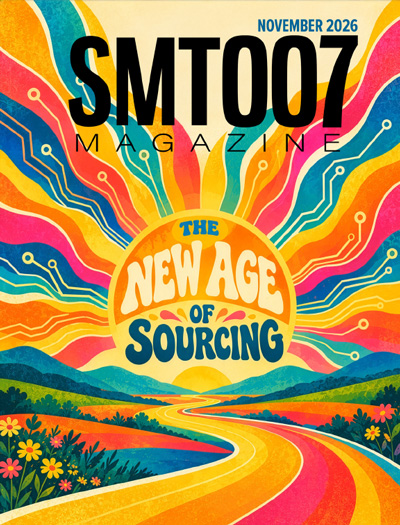
“It’s a New Age” is such a cliché. I roll my eyes whenever I hear it. In the 1969 musical “Hair,” they sang about the “Age of Aquarius,” a time that would bring peace, love, harmony, and understanding. While an “age” is an indefinite unit of measurement, these free-spirited hippies were referring to an astrological age, which lasts about 2,160 years (although its exact start is open to interpretation). Geologically speaking, an age spans 2 to 10 million years. That is, in fact, a very long time. This all just illustrates why, when that phrase gets dropped into a conversation, my proverbial cynical eyebrow gets raised.
So, should we be leaning on this familiar trope of a “new age” to describe the current state of sourcing? Surely we can’t believe it will hold up to an astrological age of 2,000+ years. No, in this case, we use the phrase to capture the feeling of a fundamental and irreversible sea change in sourcing, specifically in how EMS companies take greater control of their sourcing efforts.
We’ve all lived through this supply chain saga for the past eight years or so (some will argue it’s been even longer), but the tools and systems we’ve used to manage sourcing haven’t really changed—I’m looking at you, Microsoft Excel. Until now, that is.
Software developers are leveraging more online information from suppliers, government agencies, and OEM design teams to make innovative strides in automating vendor scheduling, component availability, and pricing. New tools have emerged over the past five years to improve in-house inventory management and to help make part ordering smarter and more cost-effective. The recent trade negotiations and rapidly fluctuating tariff rates have spurred the development of tools that give buyers a complete picture of tariff costs across each channel, sometimes uncovering hidden costs in the supply chain. The days of running receiving and stock room from an Excel spreadsheet are over, or at least they can be. So, yes, we are entering a new age in sourcing, and it’s one in which the EMS company has access to tools that provide greater insight and control.
In this issue, we focus on in-house software tools that make full use of this new environment. A common theme running through all the feature content is “data normalization.” To get the most out of the available data, all the apples need to be converted to oranges, so to speak. To that end, we bring you an article by Scott Ryan at Cetec discussing the practicalities of material management. Ralph Ricchart from MetisLogic educates us on the impact of, and the solution to, the “messy middle,” and Mark Zetter details how his product enables decision-making clarity amid the complexity of tariff stack analysis, thereby empowering purchasers and planners.
Our columnists bring their expertise to the issue as well. Nash Bell knocks down the bone pile with BGA stencil best practices, and Adam Klett clears up the role and value of ROSE testing. “The Universal Language of Quality” is on Tianming Liu’s mind this month. Finally, Alex Spurgeon from U.S. Heatstake gives readers a comprehensive technical piece exploring the fundamentals of heat staking and its ideal applications in electronics assembly.
Just like the magician’s trick of pulling a scarf out of their fist, only to have it turn into a long line of scarves tied together, the tariff articles from Zetter and Kim, when taken together, open an area of discussion deserving of an entire issue.
This column originally appeared in the November 2026 issue of SMT007 Magazine.


