











 Dan’s Biz Bookshelf: ‘Atomic Habits’
 Happy’s Tech Talk #48: Digital Twins—Integrating Design and Manufacturing
 The Chemical Connection: The Consequences of Additive Metallizing on Etching Steps





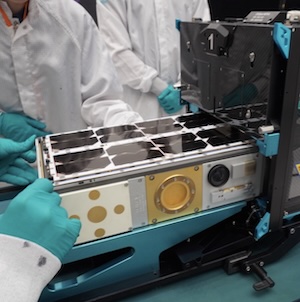
Foxconn Technology Group, the world's largest electronics manufacturing services provider, announced that its second-generation low-Earth orbit (LEO) satellites, "Pearl-1A" and "Pearl-1B," were successfully launched into their designated orbits via SpaceX's Falcon 9 rocket on the evening of May 3 (Taipei time). This mission demonstrates Foxconn's outstanding capabilities in satellite system integration and key technology verification, marking a new stage in the group's development in the field of LEO satellite communications.
The PEARL-1A and PEARL-1B satellites, employing a 6U XL design, are primarily designed for payload technology verification in the fields of communications and space science. The two satellites are being launched in a before-after flight mode to conduct inter-satellite communication experiments, hence the name. This month, they were launched into low Earth orbit (LEO) via a Falcon 9 rocket from Vandenberg Space Force Base in California during the CAS500-2 crew mission and are expected to conduct a five-year space mission.
Compared to the first-generation Pearl satellite, which focused on satellite-to-ground station communication experiments and system verification, the second-generation satellite further carries a Ka-band inter-satellite link (ISL) payload. These two satellites will not only enable broadband communication between the satellite and ground stations but will also conduct docking and transmission verification between the two satellites and monitor the space communication environment using a small ionospheric probe (CIP). Through this technology, Foxconn can more effectively master beam planning and galaxy design tools for satellite communication networks, strengthening its future application capabilities in low-Earth orbit satellite communication systems.
Hon Hai Research Institute, a subsidiary of Foxconn Technology Group, was responsible for the system integration before the launch of the second-generation low-Earth orbit satellite "Pearl," as well as its on-orbit control and data verification after launch. The "Pearl" project fully demonstrates Foxconn's strategic positioning in the space industry. The first-generation Pearl satellite successfully completed its phase-one mission in January 2026. The project team accumulated considerable experience in satellite orbit control through receiving stations in Taiwan, Europe, and Svalbard, Norway. The satellite control center, located in Foxconn's Neihu Building, conducted related experiments continuously every day during the more than two-year mission, collecting a wealth of valuable verification information.
Currently, the design of the Pearl low-Earth orbit satellite primarily integrates Foxconn's proprietary camera payload and mature internal and external components. Since the core function in the satellite industry lies in "Assembly, Integration, and Testing (AIT)," this aligns perfectly with Foxconn's long-standing CDMS (Contract Design and Manufacturing Services) business model. Feedback from the on-orbit operation experiments of the first-generation low-Earth orbit satellite allows the R&D team to iteratively optimize the system, forming a closed-loop development process. In the future, Foxconn will continue to move toward vertical integration, increasing the self-sufficiency rate of components and strengthening its industrial competitiveness.
Looking ahead, the core value of the Pearl series of missions lies in establishing "on-orbit operational experience," thereby continuously optimizing the design and system integration capabilities of the next generation of satellites. With the successful deployment of the second-generation Pearl, the Group will accelerate its focus on diverse application scenarios such as mobile communication supplementation, Direct to Cell, remote area networking, industrial IoT, and backup communications for specific fields.
Foxconn will continue to assess market demand and technological maturity, prioritizing investments in areas where it can leverage its existing manufacturing advantages and core system integration (AIT) capabilities. In the future, it will focus on system integration, testing and verification, and high-value-added services, continuously accumulating space technology strength to provide more comprehensive technical support to global satellite operators and partners, and contributing more innovative energy to the global low-Earth orbit satellite communications industry.