















 Powering the Future: Why Thermal Management Defines the Future of Electronics
 Standard of Excellence: Engineering Is the New Sales—How Technical Collaboration Wins Business
 SMT Perspectives & Prospects: Artificial Intelligence, Part 7—Data Module 2





Optics Breakthrough to Revamp Night Vision
May 25, 2016 | University of SydneyEstimated reading time: 1 minute
A breakthrough by an Australian collaboration of researchers could make infra-red technology easy-to-use and cheap, potentially saving millions of dollars in defence and other areas using sensing devices, and boosting applications of technology to a host of new areas, such as agriculture.
Infra-red devices are used for improved vision through fog and for night vision and for observations not possible with visible light; high-quality detectors cost approximately $100,000 (including the device at the University of Sydney) some require cooling to -200°C.
Now, research spearheaded by researchers at the University of Sydney has demonstrated a dramatic increase in the absorption efficiency of light in a layer of semiconductor that is only a few hundred atoms thick - to almost 99 percent light absorption from the current inefficient 7.7 percent.
The findings will be published overnight in the high-impact journal Optica.
Co-author from the University of Sydney's School of Physics, Professor Martijn de Sterke, said the team discovered perfect thin film light absorbers could be created simply by etching grooves into them.
"Conventional absorbers add bulk and cost to the infrared detector as well as the need for continuous power to keep the temperature down. The ultrathin absorbers can reduce these drawbacks," Professor de Sterke said.
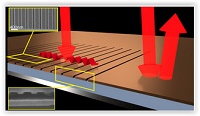
"By etching thin grooves in the film, the light is directed sideways and almost all of it is absorbed, despite the small amount of material - the absorbing layer is less than 1/2000th the thickness of a human hair," he said.
Co-lead author Dr Björn Sturmberg, who carried out the research as a PhD student at the University of Sydney with the support of the Australian Renewable Energy Agency, said the findings did not rely upon a particular material but could be applied to many naturally occurring weak absorbers.
"There are many applications that could greatly benefit from perfectly absorbing ultra-thin films, ranging from defence and autonomous farming robots to medical tools and consumer electronics," Dr Sturmberg said.
The Director of Australia's National Computational Infrastructure (NCI) and co-author, of the paper, Professor Lindsay Botten, said the structures were much simpler to design and fabricate than using existing thin film light absorbers, which required either complex nanostructures, meta-materials and exotic materials or difficult-to-create combinations of metals and non-metals.
"There are major efficiency and sensitivity gains to be obtained from making photo-detectors with less material," he said.
Share on:


Testimonial
"Our marketing partnership with I-Connect007 is already delivering. Just a day after our press release went live, we received a direct inquiry about our updated products!"
Rachael Temple - AlltematedSuggested Items
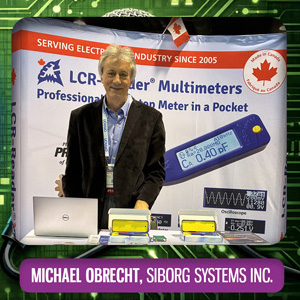
Siborg LCR-Reader Professional Multimeter
04/16/2026 | Real Time with... APEX EXPOMichael Obrecht showcases the LCR-Reader professional benchtop multimeter from Siborg Systems Inc. Obrecht discusses the compact, Canadian-made device that offers the functionality of expensive benchtop meters at an accessible price. He details versatile measurement capabilities, including LCR, ESR, resistance, capacitance, and advanced features like signal generation and oscilloscope mode.
The Future of Reflow Soldering Is Here
04/16/2026 | Real Time with... APEX EXPOMichael Hanke discusses how Rehm Thermal Systems is revolutionizing thermal solutions in electronics assembly with their innovative flux-free, no-clean soldering process. This is truly a game changing process that eliminates chamber cleaning and streamlines production. Developed with paste suppliers, this advanced technology promises significant time and cost savings while ensuring high-quality results.
Take the Mic: Smart and Flexible SMT Solutions from Essemtec
04/03/2026 | Real Time with... APEX EXPOEssemtec is known for naturally adaptive machines inspired by nature and designed for advanced HDI as well as package substrate manufacturing. Pierre-Jean Cancalon discusses new 2K dispensing and high-speed solder paste jetting technologies, perfect for NPI prototyping and flexible production environments.
Viscom AI Inspection Technology Explained
03/26/2026 | Real Time with... APEX EXPOJesper Lykke discusses how AI revolutionizes automated inspection and programming, significantly enhancing speed and accuracy. Viscom's V-Vision and ProVision software, featuring advanced AI integration.solutions for industry challenges like miniaturization and large circuit board inspection, serve the booming demand for data center and backplane boards.
Take the Mic: Customer-Driven Innovation in Materials with Koki
03/26/2026 | Real Time with... APEX EXPOKoki's innovative approach to customer-centric product development is highlighted in this show floor interview with Shantanu Joshi at APEX EXPO 2026. Learn how Koki collaborates with clients to create tailored silver and coating solutions, addressing challenges like voiding and enhancing reliability. The company's micro-alloying techniques and free analytical services designed to optimize performance and manage costs.