














 The Government Circuit: Fewer Hammers, More Scalpels—What Divided Government Means for U.S. Trade Policy
 SMT Perspectives & Prospects: What I Hope the Next Generation Will Carry Forward
 Learning With Leo: Observations from IPC Builds in Paris







Built to Survive: Drones—Designed for the Mission
Editor’s note: This is a new column written by Dr. Cody Schoener of Dow. It will appear regularly in the Mil/Aero Newsletter.
About 10 years ago, I bought each of my kids a drone for Christmas.
I can still remember the discussion with my spouse a few months earlier. Were these things actually reliable, and, perhaps more importantly, were our kids really capable of flying them long enough for reliability to matter?
Christmas morning came. The drones were unwrapped, batteries were charged, the drones flew, and smiles were everywhere. A week later, we had a small collection of damaged and largely irreparable aircraft. Their missions had ended in battles with oak trees, cement driveways, rooftops, and probably a few obstacles I never heard about.
Looking back now, however, there's actually a lesson in those broken Christmas drones: They were designed for their purpose. They needed to be affordable, easy to fly, and reliable enough to deliver some fun. They didn't need to operate through rain, dust, extreme temperatures, or other difficult environments. Apparently, surviving one of my kids flying directly into an oak tree wasn't part of the design specification.
Today, drones are still being designed for purpose. The difference is that the purpose is becoming much more serious.
We've grown accustomed to seeing drones used for photography, inspection, entertainment, and spectacular coordinated light shows. Today, drones are being designed for a much broader range of missions, including demanding military and defense applications. That creates a very different electronics challenge.
When the Weather Does Not Cooperate
A drone participating in a light show can wait for favorable conditions. A drone performing a critical mission may not have that luxury. It may have to navigate rain, dust, temperature swings, vibration, and other environmental stresses while continuing to communicate and perform as intended.
That's where my world of materials and electronics protection connects with the rapidly evolving world of drones.
Walking the Xponential show in Detroit this year, it wasn’t simply the number of drone technologies being developed that struck me. It was the speed of innovation and the pressure to manufacture these systems at scale.
For an electronics person, that creates an interesting tension. How do you build faster, manufacture more units, and control cost while simultaneously making the electronics more reliable?
I kept coming back to the same thought: Electronics protection has to become part of the design discussion, not something considered after the design is finished.
How Much Protection Is Enough?
There isn't one answer because there isn't one drone mission.
A system designed for a single-use mission has a fundamentally different reliability requirement from an aircraft expected to operate repeatedly. An inexpensive short-duration platform doesn't necessarily need the same protection strategy as a sophisticated system carrying expensive sensors, electronics, or other payloads.
Those differences can create very different protection needs from one drone to the next. That’s why I don’t think the question should be whether the drone needs a conformal coating? It’s better to ask, “What does this drone need to survive its mission?”
Once that is understood, engineers can select the appropriate protection strategy, which might begin with the enclosure and gasketing strategy. At the circuit board level, it may involve conformal coatings designed to protect electronic assemblies from environmental exposure. For more demanding reliability requirements, the strategy may include both.
Even within conformal coatings, the answer isn't necessarily one material.
Silicone, acrylic, urethane, and other coating technologies bring different combinations of environmental resistance, processing characteristics, repairability, and cost. The highest-performing material is not automatically the best material. The right material is the one that fits the mission.
That distinction becomes important as drone manufacturers move from prototyping toward higher-volume production.
The Material Is Only Half the Question
This is where another lesson from my customer conversations has become very real to me. I recently worked with a drone manufacturer that had recognized the need to protect its circuit boards with conformal coating. So, in one sense, they were already ahead of the game. They understood the why.
The challenge was the how.
Their coating operation was about as resourceful as it gets. Circuit boards were hung from coat hangers inside a portable inflatable paint booth and sprayed by hand using equipment more familiar to someone painting a room than coating electronics. Because of the realities of their production schedule, some of this work was happening late at night.
But, interestingly, it kind of worked. The boards got coated and product kept moving. They found a way to solve an immediate manufacturing problem with the resources and knowledge they had available.
But standing there and seeing the process firsthand, I realized something bigger was happening: They did not necessarily have a coating problem. It was a manufacturing-knowledge problem.
This company knew drones. They knew how to design, build, and rapidly improve an aircraft. What they did not yet know was that there were more scalable and repeatable ways to apply a conformal coating. These ways could be to increase speed, generate less material waste, improve process control, and provide a more appropriate manufacturing environment for the people doing the work.
I suspect they are not alone. As companies race from prototyping toward higher-volume drone production, processes that worked for dozens or hundreds of units can become very different challenges when production volumes increase.
Selecting the coating, therefore, is only half of the question. Manufacturers also have to determine how to apply and cure it.
A coating can potentially be dipped, manually sprayed, or selectively applied using automated equipment. Depending on the chemistry, cure strategies can include room-temperature, thermal or UV-based processes.
Those decisions affect much more than material performance. They affect floor space, throughput, work in process, automation strategy, material usage, capital requirements, and process consistency.
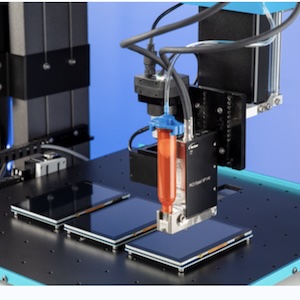
For a company producing relatively small quantities, a manual process may be perfectly reasonable. But as production scales, that same process can become a bottleneck. Selective automated coating, robotic dispensing and faster curing technologies can completely change the manufacturing equation.
That experience also reinforced something I have learned repeatedly in materials applications: The best material solution is not necessarily just the material with the best properties. It is the combination of the right material, the right application method, and the right manufacturing process for the mission.
A coating that performs beautifully after curing but becomes the bottleneck of the production line is not necessarily the best manufacturing solution. Conversely, the fastest coating process is not useful if it does not provide the environmental protection the mission demands.
Performance, process and production scale have to work together.
Protection Goes Beyond Coatings
Perhaps the most interesting part is that environmental protection is only the beginning. As drones become more sophisticated and carry greater sensing, communications, and computing capability, the electronics protection conversation expands.
More computing creates heat. More sophisticated electronics introduce concerns around electromagnetic compatibility and signal integrity. As more capability is packed into smaller, lighter platforms, materials may need to perform multiple functions without adding unnecessary weight or manufacturing complexity.
So, when I look ahead, I don't see electronics protection as just "keeping water off a board." I see a much broader engineering question: How do we protect sophisticated electronics without compromising size, weight, cost, or manufacturing speed?
It’s a materials question, an electronics question, and a manufacturing question, all tied to one thing: mission reliability. Which brings me back to those Christmas drones.
When one of my kids flew a $50 drone into an oak tree, we laughed, picked up the pieces, and eventually bought another one. Some drones don't have that luxury.
For the systems being designed for far more consequential missions, reliability has a different meaning. The electronics need to work where and when they are supposed to work, and I believe the electronics industry has an important role to play in making that happen. Because when the mission matters, protection matters.
Dr. Cody Schoener is a senior marketing manager at Dow, Inc., leading regional and global strategy for aerospace, aviation, and defense within Dow’s silicones portfolio.


