











 Nolan’s Notes: Automotive Is Gearing Up Again
 Standard of Excellence: Engineering Collaboration Has Become the New Sales Strategy
 Bridging the Pacific: Why Global Manufacturing Is No Longer Optional




Nolan’s Notes: Automotive Is Gearing Up Again
“This car has more computers than the Space Shuttle! That’s why this extended warranty is a good deal.” — Honda sales manager
In 2009, I bought a new car from the dealer, something a bit unusual for me, as I’ve tended to pick up a desirable, durable used car rather than betting on the reliability and panache of the latest model. Of the 12 vehicles I’ve purchased, only four were brand new. But back then, I needed something reliable to haul my family and all their stuff to meet the bus, get groceries, and go on the occasional weeklong camping trip.
I finally settled on a Honda Odyssey. While pitching the add-on warranty programs, the sales manager warned me that “things could go wrong.” How could I dispute his claim? I didn’t have any data readily available to question him. Now, however, with my favorite AI tool, I’ve been able to fact-check that sales manager. How reliable was the Honda Odyssey?
According to Honda and NASA: “A well-equipped 2009 Honda Odyssey had more electronic control units than the Space Shuttle had general-purpose flight computers, but not necessarily more processors than the Shuttle’s entire avionics system.”
The electronics in cars in 2009 were quite advanced, but they seem pretty primitive in 2026. Consider Tesla. Measured in trillions of operations per second (TOPS), Tesla’s HW3 computer delivers about 144 TOPS. By comparison, the Space Shuttle carried five general-purpose computers. During critical phases of flight, four operated simultaneously as a redundant set, while a fifth provided an independent backup. Even the upgraded Shuttle computers processed only about 1.3 million instructions per second. Although TOPS and instructions per second are not directly equivalent measures, the comparison illustrates the enormous capability available in today’s vehicles.
The same progression can be seen in consumer electronics. Apple’s iPhone 12, introduced in 202, incorporated a Neural Engine capable of 11 trillion operations per second. We’ve come a long, long way.
Now consider production volumes. The automotive industry produces close to 100 million vehicles annually, and electric vehicles represent a rapidly growing share. If 25 million EVs each contain roughly 100 circuit boards, including boards in cameras, sensors, lighting, airbags, and other subsystems, that alone represents 2.5 billion PCBs. Even allowing for variations in PCB counts from one vehicle architecture to another, the shift toward electrification and electronic vehicles represents an enormous market for circuit boards.
As more EVs are produced, we will see increased demand for circuit boards, and safety regulations are only adding to the electronics required to run our modern vehicles. AI and data centers may be gobbling up much of the demand for boards, but automotive remains a major volume driver.
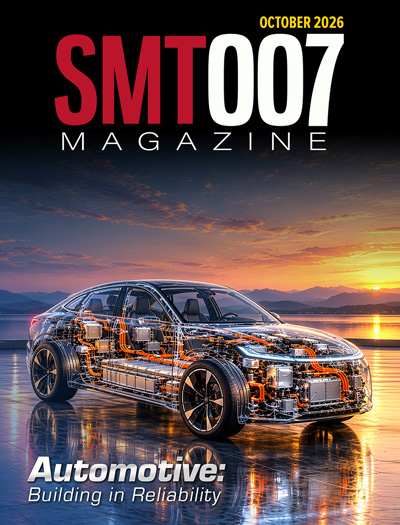
Of course, billions of boards is only part of the challenge. They also have to be assembled reliably, efficiently, and at automotive production volumes. The automotive industry has been advancing its electronics technology for many years and those demands continue to influence electronics manufacturing. In this issue of SMT007 Magazine, we look specifically at soldering and how recent developments are helping manufacturers meet the automotive industry’s evolving requirements.
In my interview with KIC’s Miles Moreau, he discusses reflow over controls for reliability. I also explore lasers as a soldering option in a separate article. MacDermid Alpha Electronics Solutions presents a case study on managing silver in production, which is very timely, given silver's recent volatility. In another article, Akrometrix advises us on alternative methods to check BGAs for warpage. We’re publishing a an Indium paper from SMTA International on voiding, and SPEA tackles automotive power board testing. Closing out our features is an interview with Stan Rak, author of this year’s article series called “The Road to Reliability.”
In columns this month, Jennie Hwang sends a letter to future generations, FSQuality’s Tianming Liu examines the concept of core competencies across regions, and Nash Bell discusses the value of interposers in rework.
I’m excited to welcome our newest columnist, Adam Klett, doctor of science at KYZEN. Adam was one of our contributing experts on the cleaning issue earlier this year, and we’re delighted to have him join us as a columnist.
Returning to my analogy of the reliability of new cars, I leaned on the automotive industry's relentless pursuit of reliability even then, and asked the sales manager, “Are you suggesting that my Honda will be as fragile as the Space Shuttle? Will I have to scrub trips on the regular because of electronic failures? If so, I don’t think this is the minivan for us.” He assured me all would be well, and 100,000 driving miles proved him right. Now, if the sales manager had been talking about a “2001 Odyssey,” and had he mentioned that one of the modules was named HAL, I might have fallen for it.
This column originally appeared in the October 2026 issue of SMT007 Magazine.


