











 The Fearless Connector: Why I Chose the Hard Road
 The Clean Truth: The Clean Truth About No-Clean Flux
 Global Sourcing Spotlight: Beyond China Plus One—Building a Truly Global Supply Network





For most of the past five years, the U.S.–Mexico–Canada Agreement (USMCA) has been the workhorse of the North American electronics supply chain. It is the legal backbone that allows a PCB fabricated in Asia to be populated in Mexico, tested in Texas, and shipped to a Canadian OEM without anyone paying a tariff at any of the three borders. That arrangement is now up for review, and the outcome will matter to anyone in electronics manufacturing who depends on cross-border production.
What the Six-Year Review Is, and Why July 1 Matters
USMCA’s Article 34.7 requires the three governments to jointly review the agreement six years after it took effect. The deadline is July 1, 2026. Each country must decide one of three things: renew the agreement for another 16 years, withdraw (on six months’ notice), or continue the agreement without renewing it, in which case the USMCA stays in force but enters annual reviews until 2036, when it expires unless all three governments agree to extend.
NAFTA, by contrast, had no formal review mechanism at all. It is one of the reasons it could not adapt to e-commerce, digital trade, or AI. The six-year review is a USMCA innovation, and even if it produces stress, the fact that it exists is a feature, not a bug.
The bad news: A clean, on-time renewal by July 1 now looks unlikely. U.S. Trade Representative Jamieson Greer has told the House Ways and Means and Senate Finance committees that he is not prepared to recommend renewal without meaningful changes, particularly to automotive rules of origin, dairy market access, and what the administration calls “economic security” provisions aimed at Chinese inputs into North American supply chains. The most realistic scenarios at this point are a protracted negotiation that produces an amended agreement or a slide into annual reviews under sustained uncertainty.
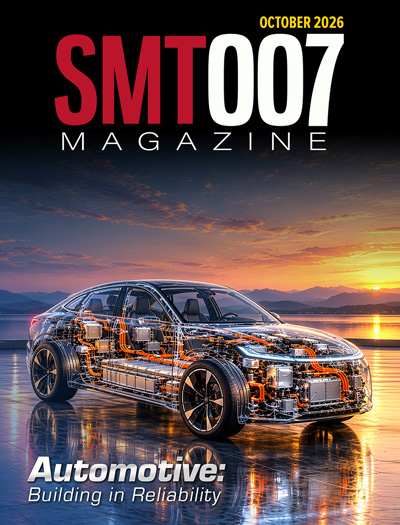
To continue reading this article, which originally appeared in the June 2026 SMT007 Magazine, click here.


