









 It’s Only Common Sense: Marketing Isn’t Fluff, It’s Ammunition
 Driving Innovation: Mechanical and Optical Processes During Rigid-flex Production
 The Chemical Connection: Onshoring PCB Production—Daunting but Certainly Possible





Northrop Grumman, NCSIST Sign MOU to Collaborate on Air and Missile Defense Capabilities
September 22, 2025 | Northrop GrummanEstimated reading time: Less than a minute
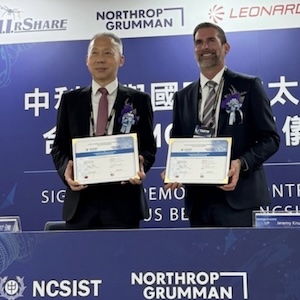
Northrop Grumman Corporation and the National Chung-Shan Institute of Science and Technology (NCSIST) signed a memorandum of understanding (MOU) to explore collaboration on air and missile defense modernization for the Taiwan Ministry of National Defense.
NCSIST is Taiwan’s primary institution for research and development in national defense technologies and focuses on the development, manufacturing and sale of defense technology to strengthen Taiwan’s self-reliant defense capabilities.
“At Northrop Grumman, we understand the crucial role of air and missile defense for Taiwan,” said Jeremy Knupp, vice president of global command and control systems, Northrop Grumman. “By leveraging our experience on programs such as the Integrated Battle Command System, which is the U.S. Army’s program of record for air and missile defense modernization, and NCSIST’s defense technology expertise, we are confident that our joint efforts will help strengthen Taiwan's readiness to address evolving threats.”
Share on:


Testimonial
"Your magazines are a great platform for people to exchange knowledge. Thank you for the work that you do."
Simon Khesin - Schmoll MaschinenSuggested Items
Ethiopian Airlines Selects Cassiopée Alpha from Safran for Fleet-wide Flight Data Monitoring
11/03/2025 | SafranSafran Electronics & Defense is proud to announce that Ethiopian Airlines has selected Cassiopée Alpha, its advanced flight data analysis platform, to optimize and secure operations across the airline’s entire fleet of 147 aircraft, including Airbus A350, Boeing 787, and Boeing 737 MAX models.
Saab Receives Order for Giraffe 1X Radars from U.S. Army
11/03/2025 | SaabThe U.S. Army has awarded Saab a contract to provide Giraffe 1X radars in support of security cooperation partners. The order value is approximately USD 46 million. The order was booked in Q3 2025.
Cadence Completes Acquisition of Secure-IC
10/31/2025 | BUSINESS WIRECadence announced it has completed the previously announced acquisition of Secure-IC, a leading provider of embedded security IP, security solutions and security evaluation tools and services.
Fresh PCB Concepts: Resilience and Renewal in Domestic PCB Manufacturing
10/30/2025 | Team NCAB -- Column: Fresh PCB ConceptsAs veterans of PCB manufacturing, we have spent much of our careers walking factory floors, examining copper circuits under microscopes, and troubleshooting plating lines when they go awry at 2 a.m. We can say with confidence that PCBs are the unsung heroes of modern life. They’re in everything, from toothbrushes and thermostats to satellites and defense systems.
Lockheed Martin Invests $50M in Saildrone to Advance Unmanned Surface Vehicle Capabilities for U.S. Navy
10/30/2025 | Lockheed MartinLockheed Martin announced a $50 million investment in Saildrone, a global leader in maritime autonomous systems. This strategic collaboration will deliver commercially available unmanned surface vehicles (USV) equipped with lethal, combat-proven defense technology.